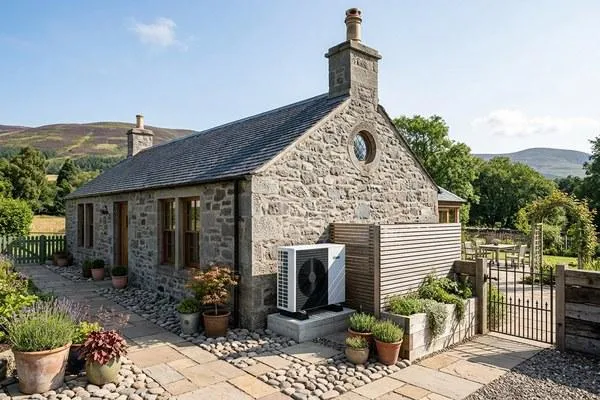
Do You Need Planning Permission for a Heat Pump in Perth or Rural Perthshire?
For many homeowners in Perth and rural Perthshire, one of the first practical questions about a heat pump is whether planning permission is needed. The reassuring short answer is that many domestic air source heat pump installations in Scotland fall under permitted development, so a full planning application is often not required. However, that does not mean every property is automatically exempt. Location, siting, conservation area status, listed building rules, and how the unit is positioned can all change the answer.
This matters in Perthshire because the local housing mix is unusually varied. A modern detached home in Perth may be straightforward. A cottage in a conservation area, a farmhouse beside a road frontage, or a listed rural property may need much more careful planning review. The Heat Pumps Perth homepage reflects that local reality by stating that, in most cases, planning permission is not required for air source heat pumps in Perth & Perthshire, but listed buildings or conservation areas may need approval and the business checks this during the survey process.
When Planning Permission Is Often Not Needed
Scottish planning guidance allows many domestic air source heat pumps under Class 6H permitted development rights. For a typical homeowner, that means the project may proceed without a full planning application if it stays within the allowed limits.
Key permitted development rules homeowners should know
Only one air source heat pump is normally allowed on the building or within its curtilage
The unit must comply with MCS planning standards or equivalent standards
It should not protrude more than 1 metre from the relevant wall or roof surface
A unit in the curtilage must not sit forward of certain road-facing elevations
Any resulting structure should not exceed 3 metres in height
These points are especially useful for Perthshire homeowners because many concerns come down to siting rather than the technology itself. If you want the design side explained in more depth, the Tier 1 post on Heat Pump Design & Specification is the closest internal guide.
When You May Need Formal Permission
Conservation areas
If the dwelling is in a conservation area, the siting rules are tighter. For example, an air source unit on the dwelling is generally only permitted if it is at ground floor level and on the rear elevation.
Listed buildings and sensitive sites
The Scottish guidance says permitted development rights do not apply within the curtilage of a listed building, and extra controls may also apply in particularly sensitive settings.
Unusual positioning or multiple units
If the proposed arrangement does not fit the normal limits, a formal application may be required even if a standard installation would otherwise have been permitted.
Perth vs Rural Perthshire: Why the Answer Can Differ
SituationLikely planning positionWhy it matters locallyStandard modern home in PerthOften permitted developmentSimpler siting and fewer heritage constraintsRural home with open curtilageOften permitted if correctly sitedRoad-facing positions and height still matterConservation area propertyMore restrictedRear elevation and ground-floor siting become importantListed building or curtilageUsually needs extra checksHeritage rules override the standard route
The main point is that the answer is property-specific. This is why local installers should review planning risk before the design is finalised rather than after equipment has been chosen.
What Else Should Homeowners Check?
Noise and neighbour impact
The Heat Pumps Perth homepage says modern units are typically quiet, often around 40 to 55 dB, but smart siting still matters. A unit can be technically lawful and still poorly positioned from a practical point of view.
Rural access and garden layout
In Perthshire, properties often have more space, but that does not automatically make siting easier. Driveways, outbuildings, road-facing elevations, and exposure all influence the best location.
Ground source questions
Ground source systems raise slightly different questions because the buried loops or boreholes create a different planning picture. The homepage notes that larger ground loops or certain rural properties may still need approval in some cases. If you are comparing technologies, the Tier 1 post on Ground Source Heat Pumps is a useful internal next read.
Why a Survey Matters More Than an Online Guess
Many homeowners search for a yes-or-no answer, but the best answer comes from a survey that considers the house, the curtilage, local constraints, and the intended unit location. That is especially true in Perthshire, where properties can range from town houses in Perth to exposed stone homes near Aberfeldy, Blairgowrie, or Pitlochry.
Frequently Asked Questions
Do most homes in Perth need planning permission for an air source heat pump?
Often no. Many standard domestic installations fall under permitted development if they meet the rules.
What if my property is listed or in a conservation area?
You should expect tighter checks. Listed building status and conservation area rules can remove or narrow permitted development rights.
Can the installer help check this before work starts?
Yes, and they should. Heat Pumps Perth says planning issues are checked during the local survey process.
Get the Planning Position Checked Early
If you are considering a heat pump in Perth or rural Perthshire, the safest approach is to confirm planning and siting requirements before the installation is designed around the wrong location. Visit the Heat Pumps Perth homepage to discuss your property, planning constraints, and the most practical route to a compliant installation.
